> For the complete documentation index, see [llms.txt](https://ms-kb.msd.unimelb.edu.au/next-lab/llms.txt). Markdown versions of documentation pages are available by appending `.md` to page URLs; this page is available as [Markdown](https://ms-kb.msd.unimelb.edu.au/next-lab/3d-printing/key-techniques/post-processing-ghabbour/fillers-method.md).
# Fillers Method
This method is on par with the No-Sand Method in terms of quality of finish but is a slightly slower process. However, it is faster than hand-sanding or using a Dremel to post process your prints. Relevant PPE such as a mask and gloves should be used when utilising this method.
### Summary
| Category | Rating |
| -------------- | --------- |
| Speed | ★ ★ ★ ★ ☆ |
| Finish Quality | ★ ★ ★ ★ ☆ |

### Materials
* High-cover aerosol paint + primer (such as Rustoleum 2X)
* Acrylic or enamel fast-drying spray putty (such as Superfine High Build Filler)
* Isopropyl wipes or similar to clean parts

### Method
1. Ensure that your printed parts are clean and dry, **wipe the parts** down with Isopropyl wipes or a similar product and let dry.\
 2. Begin by applying a **thin coat** of high-cover spray-putty to the parts. Note that the spray-putty may cause blotching to your surface if applied too thick or unevenly across your surface.\
 3. Wait **30-45 minutes** (or as instructed on bottle) between coats.
4. Re-coat your parts a total of **3-5 times**.\
3. Wait **30-45 minutes** (or as instructed on bottle) between coats.
4. Re-coat your parts a total of **3-5 times**.\
 5. Once you have applied all the necessary coats (according to how smooth you would like the finish of your surface) leave your parts to **dry overnight**. The spray-putty will fill up the gaps between the prints' layers and level your surface smoothly.
6. Apply a **medium coat** of high-cover spray paint to your part.\
5. Once you have applied all the necessary coats (according to how smooth you would like the finish of your surface) leave your parts to **dry overnight**. The spray-putty will fill up the gaps between the prints' layers and level your surface smoothly.
6. Apply a **medium coat** of high-cover spray paint to your part.\

 7. **Wait 10 minutes** between applying your paint coats.
8. Repeat the painting process **3-5 times** as necessary.\
7. **Wait 10 minutes** between applying your paint coats.
8. Repeat the painting process **3-5 times** as necessary.\
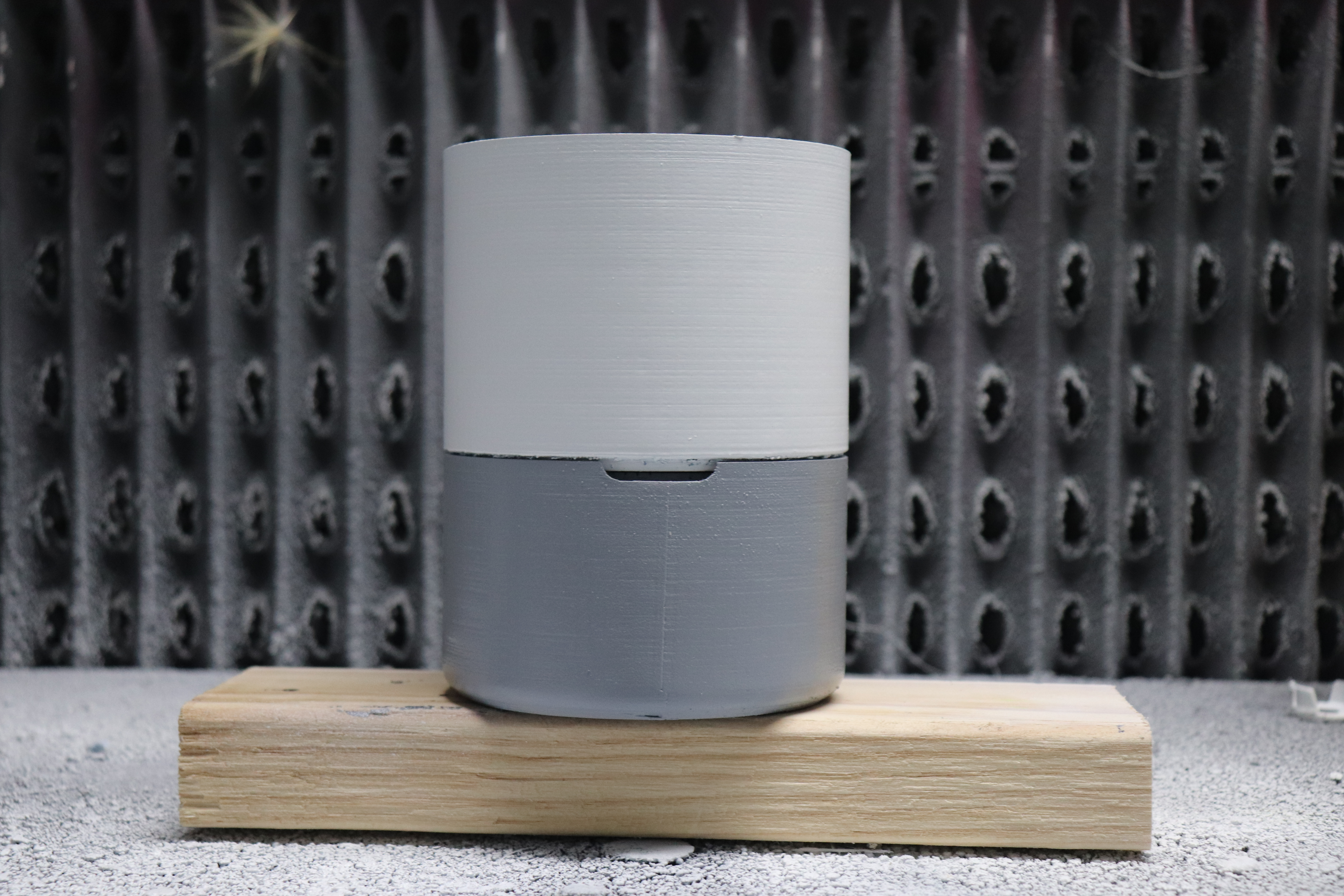 9. Wipe your parts clean and you are ready to go.